Search This Blog

Saturday, November 15, 2014

Mama Gloria: Opened A Free Clinic For the Sick And Poor, Lovina, Bali

Shortly After The Death Of Her Son, She Escaped
Australia.

She went to Bali for a much needed time of rest,recovery and healing.
Mama Gloria, affectionately  named by her patients,  has  devoted the
last 19 years  of  her life to  provide free  medical care and education
for the poorest of  the poor in Bali.


Gloria and Daughter
She was shocked to witness in Bali that there was almost  no medical 
care for the poor  and the  facilities available were  extremely limited.
With  a background, both in  social work and nurses training, she had
a calling to reach out and  help in some way.

At first, she first  began to run a makeshift clinic out of  her suitcase
in a  room in Candi Dasa on the east coast of Bali.  Eventually she
moved to the north coast area of  Lovina, which is know for its basic
friendliness and relaxed way of life. For all the years in Bali, she has
had to rely entirely on tourist donations to run the clinic. She became
the  founder and director of Bali Crisis Care Foundation, in the village
of Dusun Lebah, Kaliasem, Lovina. Bali Crisis Care provides urgently
needed medical care, health education, drop in emergency treatment
and outreach  community care. Working closely with Gloria,the staff
includes a highly trained Balinese doctor, nurses and midwives.

Amazingly, as if she hadn't done enough to make a difference, she
opened up her heart one more notch, when she decided to adopt
and raise a Balinese child from the time of birth.

Bali Crisis Care Ambulance, Lovina, Bali

Bali Crisis Care Clinic, Lovina, Bali


Bali Crisis Care Foundation, Lovina, Bali 


Little boy with serious burns after a motorbike accident.


Same little boy before the motorbike accident. 
His father runs a business from a motorbike.


On  my first trip to  Bali, I too was  grieving the loss of a dear friend
and it was  his death that led me on the path of looking for some way
to be of service, my own fulfilling niche.

From day one, Bali seemed like a second home to me, where I slept
more  soundly,  connected  with  people more  easily, found  magic
moments  wherever I went. The  culture is  beautiful,  exotic, filled
with love, peace,  adventure  and  it was  much like a little paradise
for  me.

I've  heard that this is  a common  experience for tourists when they
come to Bali!

However of course, Bali is Not a Paradise for the Poor!
At  the same time  that I experienced  the bliss, I also  opened up
my eyes and saw the overwhelming poverty, deformity, pain and
suffering.  Newborn  babies are still held hostage in the  hospitals
until families cough up the money to pay the entire bill. There are
times  when families must  sell their home  property  before  they
can  take their baby home. People die at  a young age, needlessly
because they cant afford healthcare. 

When I toured  a government  hospital, I witnessed what  it was
appalling. One small bathroom for a large room  of patients and
their families, who camp out next to their family member's  bed.
Old, bloody  rags  lying  around  on  the floor. The lack  of well
trained doctors and nurses are another problem.

After  meeting Gloria, each  time  I'd visit Bali, I felt inspired to
bring an extra suitcase of donations, including prescriptions and
medical supplies. At that time it became easy for me  to become
a much needed fund raiser and with the help of donors from  the
U.S.A and other countries,  the Bali Crisis Care Foundation was
able to eventually buy land and build a clinic.

I always  love visiting and hearing  about the projects she  has been 
involved with,whether it be  the organic gardening  group, a sewing
program, deliveries of needed wheelchairs, free water and recycled
mattresses to the needy,  and  the list goes on.  All those projects are
in addition to child deliveries, taking care of  patients  with  injuries,
auto accidents, tuberculosis, dengue fever, typhus, rheumatoid fever,
polio and intestinal infections.


Tour the Clinic and Make a Donation.

Gloria will give you a tour of the clinic and share fascinating stories
about everyday life in Bali, about patients who have survived well
because of their care at the clinic, about unusual medical cases and
about treatments offered by the local balians or dukans. (Balinese
medicine men) Gloria has an infectious sense of humor and you will
feel enfolded with her loving care when you meet her.

Anyone wanting to donate to Bali Crisis Care Foundation can transfer
money via Western Union or deposit into their banks in Indonesia and
Australia. If you are coming to Bali for a vacation you are welcome to
visit her in person and hand over any kind of donation.  Although, on
the website, she gives tips on what they need. When visiting the clinic
in Lovina, you  can get a  better understanding of how your money is
allocated.  Please email  her at least a few days in advance, if you are
planning to visit.

Contact Information:
www.balicrisiscare.org
Phone: +62 (0)362 422 86,
Mobile: +62 (0)81 2377 4649
Email: Balicrisiscare@hotmail.com

(A few of the  photos were taken from www.balicrisiscare site.)


Thursday, November 13, 2014

Wayang Shadow Puppet Show and 3 Month Baby Ceremony

 
Since it was an auspicious day in Bali, a day set by the priest, it
was good timing for a ceremonial Wayang Shadow Puppet Show
(Wayang Kulit) and a 3 Month Baby Celebration. I was very
excited when my now best friend Ketut, gave me a special
invitation to attend his nephew's ceremony.


When babies turn three months old, they are blessed by the priest,
given a special Balinese name and finally allowed to touch their
feet to the ground. Before 3 months, they are considered to be like
little Gods and too holy to touch their feet to the dirt.  The Wayang
Shadow Puppet Show is also performed on the same day, but only
if the baby was born on a particular inauspicious day on the
Balinese calendar, to prevent  having emotional problems or a
moody personality.  

At 6 pm, I headed out to the ceremony and  it was already starting
to get dark as I walked a few blocks to Ketut’s nephews house.
Since Ketut had gone to another ceremony at his village temple
and I would be on my own, for this evening. (so many ceremonies
....so little time!)  Honestly, it seems like for a local Balinese, the
required ceremonies are endless and the preparations for offerings
are very time consuming.

Trying to find a specific place in Bali is sometimes complicated,
even with directions.  Look for the stone sculpture, the shell door,
the mango fruit stand, turn left at ? shop, walk so many
kilometers (I don't think In metric!) and you will find a gate with
decorations.  In these situations, it is best to think of it as an
adventure and not be frustrated, because there is a darn good
chance of getting lost.

When the road split, I went to the right only to later find out I
really should have gone to the  left.    Through the trees, on the
other side of someone's property, I couldn't see anything, but I
could hear what sounded like a  priest singing in a  strangely
animated unusual language.  (shadow puppet shows are
performed in a Javanese language) 

I guess I’ve been to Bali enough times now, so that I can
almost sniff out where a ceremony is going to be by watching
the people carrying their offerings.  However in this case, the
road was deserted.

I felt  trapped when I saw the street's dead end and feared that
the nephew's child ceremony might be finished by the time I
got there, if I were to backtrack my steps back to the split in the
road.  Then suddenly when the impulsive part of me took over,
I took a short cut through someone’s overgrown side yard and
hen back yard.  I know what you'd say. "That is much too
dangerous, what about the angry dogs or the angry neighbors?"
Yes, I did think bout the dog aspect, but I didn't see and I would
have gone back if I did.  Also, to be honest with you, I've never
seen an angry Balinese, although I know that they too, must have
a bad day.  I walked cautiously in the direction toward a loud
speaker, weaving my way to where I thought that Ketut’s
nephew’s ceremony was located.  Along the way,there were a few
chickens and a couple of piglets scattering about in the dirt, but
all was quiet and it made me think that these neighbors must be
already at the ceremony.

I arrived at the nephews terrace and in enough timing, to see
the puppet show, with the priest chanting, singing and in the heat
of action, performing the holy ceremony. The puppets are flat
people figures with movable arms made of buffalo hide attached
to a hand held post.  There was  a hanging pot burning with hot
oil flickering flames which casted a shadow onto a rice paper
screen. Two men were accompanying the priest by playing
Balinese gamelan  music and as usual, there with a sweet wafting
of incense.  Most of the shows are based on epics of Ramayana
and Mahabharata, stories of romance, adventure and comedy.

One of the best places to see a shadow puppet show is in Ubud,
and you will need to ask around as for the location.  Since the
show may last several hours, you might want to plan ahead...
Have patience and bring a cushion to sit on, unless of course,
you are American and gifted to have your own natural cushion.
 
 
Wayang Shadow Puppet Show
 
There were a few children on both sides of the white screen watching
the show, but they didn’t appear to show as much interest as I would
expect.  As you can see, the oldest one sitting next to the screen is
either texting or playing video games. 


Wayang Shaadow Puppet Show


3 Months Old Baby Ceremony
 
 
As part of the ceremony,  the high priest sprinkled holy water on
Ketut’s 3 month old nephew, the grandmother was part of the
ceremony and wrapped the baby's head in strips of colored cloth. 
Peanuts and cigarettes were passed around during the ceremony. 
When all was over, the family ate a plate of food including
roasted pig, and passed around with glasses of palm wine. 
Eventually, like a small circus show, the priest packed up his gig
and headed out for his next ceremony and puppet show, as he
two more to perform that evening.


  5 minute excerpt from an Indonesian puppet show.
                                    

After the event, it gave me the opportunity to release a few of
my colorful stickers to the children.  They were all very polite,
and I was surprised that there was no grabbing of extras, like
I've seen at home.  They took only their one sticker each,
followed by “terima kasih” (thank you).

Then I walked back home in the dark for 2 blocks on a secluded
country road and to balance things out, 1 block on a busy road. I
was grateful that Bali is still a fairly safe place to be, especially
being a single woman traveling alone.

I have to admit though, that  if I had planned better, I would have
taken my pepper spray with me, for a sense of security and
protection, which is effective against both dogs and people.
However, being the tidy person that I am,  it was packed in my
suitcase!  Fortunately, in all my travels I have never come close
to needing anything for protection, but I don't want to push my
luck!

Monday, November 10, 2014

12 Inside Travel Tips - How To Meet The Locals


Off The Beaten Path,  Ubud, Bali
 
Have An "Off The Beaten Path" Experience!

While trying to be safe, you might feel like you should
stay on the beaten path, attend only advertised events,
and always stick with a group. This approach is a mistake.

You can have far more fun with authentic,
down to earth experiences, if you put yourself out a little
and try some of tips below.  A trip is always more interesting
if you get a personal invitation to a family event, whether it
be to dinner at their home, a wedding, a funeral (Bali
cremation ceremony) or a trip to the market to buy durian or
mangosteen.

As a plus, when you finally return home, you will hopefully
have fascinating stories to tell your friends and family.

Always, use common sense for safety, but don't be afraid of
walking down a back road or of talking to strangers.

After years of traveling, I've come up with the best tips I can
think to meet the locals and to get interesting invitations.
I have tried all of them and of course,  I'm always looking for
more ideas.

Travel Tips Useful In Bali And All Locations:

Remember that in Bali, it is a culture where people are
friendly and polite, but also can be timid and sensitive.  Try to
speak softly,  to be gentle and to be respectful, as much as you
can. Use similar gestures as in the country you are visiting. 
The Balinese sometimes like to fold their hands together as
in prayer when they are greeting or saying good bye to one
another. 

1. Learn a few phrases in the native language.
Greet everyone as you go walking  along the streets, or
are having a bite to eat, or are taking a ride on public
transportation.
 
A few phrases will make you popular with the locals,
will show that you are interested in the culture, and they
are good  conversation openers.

Below are some of my favorite Indonesian sayings that are
guaranteed to get the right kind of attention:   If you are in
another country, use these same phrases, but of course in the
correct language.  The time it takes to learn a few phrases is
time well spent! Write them down and carry them around,
while you are learning them.

I used this site before my trip and there are many more:
Learn Indonesian With Free Videos

Terima Kasih….thank you
Selamat pagi......good morning
Selamat malam......good evening
Sampai jumpa nanti….see you later
Apa kabar…..how are you?
Baik baik…..fine
Saya nama…..my name is..
Jalan jalan……the path or the road
      also means, "walking walking"…..a good
      response when Balinese ask, 'Where are you going?'
Mimpi manis…..sweet dreams
Enak sekali…..delicious
Cukup bayi.......pretty baby 
      (don't make a  mistake, like I did)
      I once pointed to a lady's baby, while smiling and
      said, "cukup babi" - meaning.... pretty pig!!
 

2. Look like they do....Do what they do.
If possible, try to mirror the other person and the culture, so
that they will feel comfortable being around you and you
appear to be one of them.

Try to dress as much as possible as the people do.  The last
thing you want to do is to stand out, looking like an ugly tourist.
In Bali, buy a sarong and scarf on day one.   Either wear them or
carry them in a small backpack  wherever you go, so that your
will be ready for any spontaneous ceremonies.

When you see the Balinese walking with offerings on their
heads, follow the procession, because they are going to the
temple.  Be sure to put the sarong and scarf on before entering
the temple and avoid being disrespectful.

Men or women: Pluck a flower off one of the many flowering
bushes or frangipani trees or even a fresh one that has fallen on
the ground. Then  tuck the flower  behind your ear or place it in
your hair. The Balinese are especially amused if you are a man
and do this, since it means you have been praying
and have returned from the temple.

3. Pack a few donations from home.
Bring them to non-profit  organizations of your choice,
including a medical clinic, an orphanage or handicapped
center.

Share with children, waiters, waitresses, hotel staff, tour guides
and the elderly.

Bring stickers, small toys, candies, chocolates.
Before my departure, I ordered hundreds of stickers, that
were colorful, glittery, jungle animals, popping eyes, and little
valentines. Since I could not find that many children to give
hundreds of stickers to, I started to use them for adults.  I would
leave them as a surprise with the restaurant tip, or leave them in
random places.  Surprisingly, the adults seem just as happy to
receive stickers as the kids are.

Be respectful of the culture
Carefully choose what to bring.
For example, personally  I would not bring toy soldiers dolls
loaded up with guns or bags of sexy blonde Barbie dolls.
For this,  you will have to use your own judgment.
The donations will give you a foot in the door and the Balinese
 are always open to showing you around and answering your
questions.

Avoid custom problems:
Don't bring any items that customs might think are brought it to
start a business, such as electronics.  They will confiscate them
from you.

I once brought a suitcase of donated prescriptions, antibiotics,
medicines for high blood pressure and cardiac, vitamins, etc. 
They were very suspicious of me and my suitcase contents.....
something to do with illegal drugs perhaps?
Plus, not all the donations met the requirements of having an
expiration date of 6 months out.  Therefore they took the entire
suitcase and I never saw it again.

4..Stash away some  picture postcards from your home city.
If there is someone you like or someone who has given good
service, write them a thank you note on the back of a picture
postcard from home and include your email address. 

5. Always ask permission first and take photos
of people / children.Then  have them developed at the local
photo shop.  You might even choose one photo to enlarge
and buy a frame or photo album. Then deliver them to the
same person who originally posed for you.  They will be'
surprised, love it and appreciate your gesture.  They may
even tape it to their wall at home and remember you forever.

6. Tell everyone you meet that you are interested in events.
Such as ceremonies, family events, sport events, etc.
Eventually someone will know of something interesting
happenings.  Most ceremonies are scheduled on auspicious
days set by the Balinese calendar or during the full moon

If you overhear someone talking about an event, ask them
about it and say, "May I come?"  Most of the time, they will
say, "of course".

7. Bring a few photos from home.
of your family, your pet dog or cat,  the front of your home or '
your work place. The Balinese love to see how you live and
they are very family oriented.    Chances are, most the Balinese
will never be able to afford to leave the island.

8. Make an effort to smile.
Smile at everyone and everywhere with all that you
encounter.  Put yourself out there and  will see a positive
effect.

9. Reach out online.
Try www.couchsurfing.com if you'd like to be hosted by
a local person and are willing to sleep on their couch.
They may show you some little out of the way restaurants
and introduce you to their family.
Try www.servas.org  which is an international, non-profit,
non-government organization  that focuses on hosting for
friendship and peace.
Try www.meetup.com  for local events.
But be aware that some of these sites may hook you up with
other travelers instead of with the locals.

10. Travel slowly.
Take your time.  Take a month off .....(take a year off!) and
consider planting roots  in one or two  locations.  When people
repeatedly see your face, they begin to trust it. Since getting to
know the locals can take a little time, don't fly in and rush out
too quickly. Instead, do your best to chill out and relax for
awhile.

11. Look on local bulletin boards.
Check for unannounced events, grand openings, gatherings, etc. 
You don't know what you'll find until you look.

12. Always be curious, inquisitive and ask questions!
Once I took an evening Bali walk and saw in the ditch that a pig
was being slaughtered with the insides being pulled out of the
belly.I've always loved anatomy and physiology, so that in itself
was fascinating for me.


Roasting pig for a celebration
But as I moved closer and began watching with enthusiasm,  one of
the men said that the pig was being prepared for his daughter's
wedding the very next day.  I was friendly and curious, asking a few
uestions.  Then guess what happened?

I received an invitation to the wedding as a special guest and it was
an awesome Balinese event.  Of course, it might have been a
problem if I was vegetarian, but I'm not. And it was no surprise that
almost all the dishes contained pork.

Events like these are happening all the time, everywhere and by
following few tips, it will increase your luck!

I am always looking for new tips.
If you have any.....please share them!

Saturday, November 8, 2014

"Sweet And Sour" Children's Dance - Lovina, Bali

On the Beach, A Man Introduced Himself
As Jimmy Hendrix.

His name definitely got my attention.
Jimmy Hendrix said he was a teacher for a children’s dance
group and announced that there was a performance that very
evening. As a good salesman, he flashed a paper with written
testimonials and emphasized that there would be no charge,
but they would accept donations.  Yes of course, count me in! 
I love going to unplanned, behind the scene events and I was
looking forward to something new, especially with children.

At 7pm, I was collected from my hotel,  along with several other
guests and taken by jeep along a dirt country  road  for about
two miles, to a family walled in compound.. The outside area was
dimly lit, we were seated on wooden benches in a  dusty area and
we could view a small, covered stage area.

Beer was for sale, there were a few Germans in the group  and it
happily seemed to be the beverage of choice.  All was quiet for a
moment and just then, there was a non-rehearsed song and dance
act.  A mother chicken and her tiny chicks began harmoniously
peeping and scampering one by one, across yard.
Ha...I mused.  They had become the opening act!  .

While the young boys of the group played an out of tune, difficult
to listen to music, with  instruments  including Bali gamelan
(large xylophone), drums and flutes, the girls sat cross legged, in
the front row with looks of boredom. While the girls waited for
their moments of performance, the boys came out, one by one in
brightly colored  Balinese costumes, as a Garuda bird, a Rangda
witch and a funky Monkey.

It was certainly unlike any real professional performances that one
would see in Bali.  Yet, I enjoyed the whole experience and when
the children entertained, they were cute.


Jimmy Hendrix and the Children's Dance, Lovina, Bali


A Garuda at the Children's Dance, Lovina, Bali


A Rangda (the witch) at the Children's Dance, Lovina, Bali
 
However, at the very end of the performance, there was a surprise.
Jimmy Hendrix came around to each attendee with a clipboard
(not a basket) which listed past performance donations of amounts,
300,000 rupiahs ($25.00 U.S.)  and more.  As everyone watched,
with family members hovering around our group, we were asked
to record our name, our country and the amount of the donation
onto the clipboard.

While I’m not one to succumb easily to pressure like this,
I thought for a moment , then recorded and gave 80 rupiahs
($7.00 U.S.) as a donation, the same ticket price of a Bali
professional performance. Then, I passed the clipboard on to
the German guy sitting next to me for his donation. 

However, by the family's  tone in Indonesian and the scornful
look on their faces, they were unhappy with the amount of my
“donation”!  Although my Indonesian is basic, I could easily
pick up on the intonation of their voices,  the aggressive energy
and it was not a pretty moment.

In the beginning, it was so sweet and innocent.
And then, suddenly the event had turned out sour! 
I easily flashed back on a couple of life circumstances that
started out romantically sweet and turned out sour!

However as I  try to do in life, I will always choose to remember
the pure, innocent, sweetness in this "Sweet and Sour"
experience. Sometimes I get carried away with Bali bliss, which
can easily be done because  I am only here for a couple of months.

When in reality, anyone who lives here in Bali will announce  ......
"All is Not Paradise in Bali".


Thursday, November 6, 2014

Putu and Family - Unique Bali Life Struggles

 
I Met a Charming, Sweet Balinese Girl.

She  always called me “Mom”
while I frequented  a sea side restaurant in Lovina 15 years ago.
Putu was just a young teenager then and lived nearby in a tiny
rented room. But since then, she  has grown up, gotten married
to a local boy and has two children.  
 
Because she is first born, her name is “Putu”.
She married a first born boy and his name is also “Putu”
 
Their first born child is also named “Putu”.
That makes 3 Putus in the family and a bit confusing, to say
the least!


Putu, Putu, Putu and Made at their house.


Then came along their baby Made, a Balinese second born
child's name and thank God,  it broke the cycle of Putus.
 
Putu, (the girl who calls me Mom) and Putu (her husband)
eventually were able to by a small, basic house, with funding
help from an aunt,with the plan that she will live with them
forever.   They have a couple of chickens confined in tiny,
crate cages, a small vegetable garden and a mango fruit
tree on the property.
 
They have no furniture, except a couple of mattresses. 
However,  they do have a huge rooftop satellite dish, a flat
screen television, a 10 in Samsung Galaxy tablet used by the
daughter, a music boom box, 3 motorbikes and 3 cell
phones. Internet phone time is purchased by the minute and
can be renewed at roadside food shops.
 
If a Balinese is lucky enough to work in a busy restaurant,
it might pay up to 1,000,000 rupiahs (USA $80.00) a month. 
However, working as a driver with a car, might  be an even
better career choice, although the money is up and down,
depending on the tourist season. 

I'm told that it is easy to buy a motorbike or car, with little or
nothing down and and a commitment of high bank credit
(2.5% / month)  Many have several motorbikes, all on credit,
which of course, reeks havoc on the roads with traffic, noise and
pollution. ( and not getting any better).  Legally,  the Balinese
need a license to drive, but it is not well enforced
and believe it or not, it is not surprising to see a 10 year speed
by on the road!
 
 
Putu and baby in front of Rini Hotel, Lovina,Bali
 
Vehicle ownership on Bali is rising at an annual rate (12.42%) that
far outstrips the growth in new roads (2.28%), according to
government statistics. "Traffic will get worse and worse," I Made
Santha, Bali's traffic chief, predicted in February.

The Balinese are big on eating snacks from street carts, which are
fairly cheap and convenient.  They occasionally eat at local warungs,
as a break from the drudgery of cooking preparation.  In the photo
below, we sat on the little wooden bench and had just finished eating
Gado Gado, a popular Balinese dish.  Behind the snacks there is a
small kitchen with a hot plate for cooking.  As you can see, there was
no counter, so that means you just hold your food. Most Balinese don't
use utensils, so that is one less item to deal with.

I had never seen so many flies as there were here at this shop and it
was soooo annoying to try and protect your food.  I'm sorry, but I
couldn't help thinking about where those flies had been with their
little contaminated feet. An elderly lady had an old partially split,
crusty, fly swatter and she was literally swatting continuously at
everything, like a wild woman. At one point, to give the poor lady
a well deserved break, I took hold of the fly swatter and began my
own swatting mania.  I didn't mind killing a few flies, but it seemed
like a losing battle.   
Don't worry though...........I had no fly problems elsewhere in Bali.
 
Putu and children - assorted fried snacks at the warung, Lovina, Bali

Ceremonies may take 1 -2 hours a day for the woman, including time
to make the offerings and the time to do the rituals in their family
temple. Since there are many, many village ceremonies, it may take
days of preparations.

Still they don’t complain……There is peer pressure in the
neighborhood and besides,  it brings them  good karma.

Tourism has overburdened Bali, yet they love it and don’t realize
that in a way, it is a form of island suicide.   Massive overbuilding
and the infrastructure has not been able to keep up with the
increasing numbers of tourists and expats.

 The popular Bali proverb is,
“Goodness shouts, evil whispers,"   But money talks.

Tuesday, November 4, 2014

Lovina Updates - Sleeps, Eats, Boats

Lovina, north Bali  is still quiet and inexpensive. 

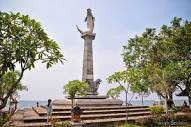
1.The iconic dolphin statue:  Appears to be improved and shiny,
a great place to watch the sunset and to take photos.


2.  Dolphin boats:  Tourists still go out to see the dolphins
early in the morning just as they did 10 years ago.  The boat
captain will either text you or knock on your door in the
morning to wake you up.  There are 3 times as many boats
that go out and they are much more attractive than before.
Some even include life preservers.  The price remains cheap
60 rupiahs ($5.00) paid either to your hotel or directly to the
boat owner for a 1.5 or 2 hour boat ride.
 
3. Street dogs:  Still wander the streets  as they did 10 years
ago, but are fewer in number and look better fed.  However,
when the sun goes down, they suddenly seen to have a split
personality disorder.  The daytime sleepy dog becomes
suddenly becomes aggressive and vocal. 


Rabies problem:
I refrain from petting or getting near the dogs, since there is
an ongoing rabies problem here for the last 8 years on Bali. 
Sadly, it was reported today that a 9 year old Bali girl died
on October 31, 2014 from suspected rabies. The situation is
not under control, although Bali has tried vaccinations and
dog eliminations.
http://www.balidiscovery.com/messages/message.asp?Id=11198

To be on the safe side, I received a series of 3 pre-exposure
immunization shots before coming to Bali, knowing I would
be here for two months and wandering into the country
locations.  If bitten, I would still need a couple more shots,
but my immunity has already started.  Also,  Bali is not
consistently  with medical supplies - vaccinations,
medications, treatments or just health care in general.

4.. Hotels: I spent one night at the Rambutan Hotel, one
night at the Ansoka Hotel  and the remainder of the nights
at the Rini Hotel.  These hotels located in Central Lovina
Beach area, are one block or less from the beach and the
rates listed are negotiated and for low season.

The Angsoka Hotel, near the dolphin statue / beach
rents for about 240,000 rupiahs ($21.00 U.S.) a night for air
conditioned room, hot water, nice pool.  Most hotels have
free Wi-Fi. There is a full breakfast, an outside bar and
massage tables where you can get an inexpensive massage.
www.angsoka.com

The Rambutan Hotel, on Jl Mawar,  rents for 350,000
rupiahs ($30.00 U.S.) has a fan cooled room, hot water, 2
pools, lovely outside dining and a deluxe breakfast,
with good unlimited coffee. (not the usual thick Bali
coffee) The fan cooled rooms at Rambutan seem to be
pleasantly cool.
www.rambutan.org

The Hotel Rini, on Jl Mawar,  rents for 260,000 rupiahs
($22 U.S.a night) and that price includes continental
breakfast, a lovely pool, air-conditioning, lovely tropical
surroundings, a partially outdoor garden bathroom and a
cold water shower. Because it is hot in Lovina, the cold
water is not all that cold and is in fact, refreshing. There
are many Dutch and French guests.
www.rinihotel.com
 
5. Restaurants:  There are many more choices, but the
following are near the Rini Hotel.  They are my favorites
and I went to one or both of them everyday.
        
        Warung Ayu  is a very popular but small, offering
        the Balinese dishes  Cap Cay and Nasi Goreng  for 1
        5,000 - 20,000 rupiahs. ($1.50 U.S.)

        J.B.s Pizza Restaurant has a new airy, larger location,
        offering the J.B. Special pizza for  35,000 rupiahs.
        ($3.00 U.S.)  They also have lots of Balinese /
        Indonesian food.

        For those of you who are beer lovers, you can get a
        Large Bintang in Lovina for 25,00 rupiahs ($2.00 U.S.)
,
6.  Entertainment:
 
The "Poco Bar" near the main road is popular and fun,
has music 7 nights a week and is popular with the German
guests. Be warned that the music is loud - so bring your ear
plugs.

The "Sea Breeze”, usually my favorite, right on the beach
has the best sunset view and a promising breeze, but they
didn't  offer live music during this visit.  The once dirt floor
has been upgraded with cement embedded with stones.
The sunset mosquitoes have not really changed!

Other restaurants have guitar players occasionally, so there
is always something going on.

7. Hawkers:  Continue  to congregate in the statue location, 
selling sarongs and shells  (She sells sea shells at the sea
shore :) or baggies of fruit pieces.  $5 U.S. will buy you a
coconut oil massages, if you don't mind lying down on a
sarong covered cement slab near the black lava sand  beach.
Here you can buy tours to the hot springs / Buddhist temple.
 
8.  Shopping stalls:  They were built by the government
bordering the beach, and all an element of sales pressure
whenever you walk by.
However, there remains an old path of broken up sidewalk
slabs along the beach and are a little  further from the stalls
which means avoiding saying "no thank you" a hundred
times.
 
9. There was a precious stream that used to flow into  the
Bali Sea, where children laughed, played and went fishing. 
Now it is  polluted with plastic and garbage and in fact, it
is stopped up.

10. All in all, I still like coming to Lovina.  Compared
to other tourist areas of Bali, Lovina is still fairly cheap!
It is quiet and peaceful,  has a few motorbikes but nothing
compared to Ubud.  There is good snorkeling and diving
about 1.5 hours to the west.  A couple of retired folks
said there were intending to stay for 2 months in Lovina.
However, most tourists here are in their 20s, 30s, 40s.

Monday, November 3, 2014

The Dark Side Of Paradise

Dr Suryani rescues people locked up at home in cages,
offers meditation, empowerment classes,and treatment.

Ever wonder what is behind  the beautiful smiles in Bali?

Surprisingly, there are increasing numbers of depression and suicide, various forms
of mental illness, child prostitution and foreign pedophilia.

Fortunately, Bali has an amazing psychiatrist, named Lul Ketut Suryani MD,PhD
who makes it her mission to help the Balinese maintain their balance and preserve
their culture, while they struggle in a rapidly changing world.

Most tourists want only to focus on the beautiful side of Bali.....and you can't blame
them. Who wouldn't want to focus on Bali's paradise, the luxury hotels, heart felt
smiles, dreamy beaches, a unique culture and lush, green landscapes?  These are
some of the reasons that I was attracted to Bali in the first place!

Luh Ketut Suryani, MD, PhD
I met Dr Suryani in San Francisco.

While walking along the chaotic Market St in San Francisco, something magnetically
pulled me into the lobby of CIIS (California Institute of Integrated Science). Perched on
the countertop was a flyer of the evening's speaker, "Dr Suryani,  a Balinese psychiatrist
speaks on Balinese cultural challenges". At the time, I thought, "What an exciting
coincidence since I am planning a trip to Bali in only a few weeks."

Later, I returned for the talk and met Dr Suryani, who graciously invited me to her home,

to spend the day with her in Bail.  I didn't know it at the time,  but  Dr Suryani is the
leading psychiatrist in Bali.

As an expert on Balinese culture and spiritual practices, she is the founder of "Suryani
Mental Health Institute" and the author of several books:  "The Balinese People",
"Trance and Possession in Bali", and "Living in the Spirit".  She is an activist in working
with women, children, and the elderly, with a focus on mental illness, suicide, pedophilia
and prostitution.  

There are only a handful of psychiatrists among the 4 million people of Bali, with an
estimated 7000, who are abandoned and untreated.  When Balinese people are ill, they
will usually see the local priest or healer, called a balian or duka, as their first
choice because historically that is what they have always done and it is their belief
that the healer will cure their condition. Being supportive of these beliefs, Dr Suryani
will often first arrange a session for the person with a traditional Balinese healer.
Afterwards, while building up their trust,  the person and their family are hopefully
more open to the possibility of using western medicine and taking medication.   In
Dr Suryani's practice, she weaves together the ancient healing methods of Bali with
modern, western, psychiatric treatment.

Four weeks later, I met up with Dr. Suryani in beautiful Bali.

I took the one hour cab ride to the capital city of Denpasar to meet Dr Suryani.  Her
home was an open aired, Balinese style home with large, carved, wooden furniture,
where I sat comfortably and sipped a cup of ginger tea.  She has a total of six sons,  
with plenty of testosterone roaming the house.  One of them decided to follow her 
legacy and also became a psychiatrist.

It was her son who drove us to the community center, where there were up to a  
hundred people, sitting on floor pillows, waiting patiently to practice the meditation
techniques taught by Dr Suryani.

Weekly meditation groups in Denpasar, Bali.


Dr Suryani's weekly meditation group in Denpasar, Bali

Dr Suryani spoke in Indonesian into a microphone, little of which I understood, except of
course whatever I got through osmosis.   To my surprise,  there was a camera crew
present and later I was told we would be seen on Bali TV later in the week. Dr Suryani
introduced me to the camera and I have no idea what she said,  good or bad, although
I thought that I heard a reference to CIIS in San Francisco, where I first met her.  

She told me that part of her mission is to help preserve the Balinese culture, to reduce
stress and the high suicide rates, by teaching meditation, relaxation and using
reprograming techniques. With ongoing tourism, new technology and globalism, the
Balinese people are having difficulty keeping up with the rapid changes.

The Balinese have come to a place where they are "stressed out" and need extra help to
stay in balance!    (sound familiar?)  

Increasing problems in Bali.

After the community meditation group, I accompanied  Dr Suryani while she saw her
patients and adjusted their medications.  Because depression and
suicide are an increasing problem in Bali, she decided to set up a couple of suicide
prevention, crisis centers.  She also holds public workshops for families, providing
education, empowerment exercises,  as well as running a weekly women's TV program.

No one wants to admit it, but there is a sharp increase in prostitution and sexual 
exploitation of children.  The young boys and girls gradually filter into Bali by ferry boat, 
mostly from the island of Java.  They set up business mostly in the Kuta beach tourist
areas. The customers of course, refuse to wear condoms and since the prostitutes need
the money, they feel that they have no recourse but to go along with it.  Currently, the
HIV rate among the prostitutes is 20%. 

It is a dichotomy that girl prostitutes have a negative image, are often abused and are
paid poorly, while male gigolos are well regarded, have an easy life and are paid
well.

It was appalling to me to learn about the huge influx of foreign pedophiles, preying on
innocent Balinese children.  The village children are poverty stricken with families that
can be easily be bribed with food and clothing.  The pedophiles present themselves
as friendly, well liked humanitarian workers or English teachers from other countries.

It makes me wonder who is trustworthy and who is not, in this changing world and
of course, this is happening elsewhere in the world.  But in Bali, there is a perfect
breeding place for pedophiles because the local poor Balinese are trusting, open and
welcoming, as part of their culture.

Dr Suryani spoke of the exploitation with tears in her eyes, commenting on how the once
peaceful paradise is turning into a sexual amusement park for tourists and perverts.

Dr Suryani has worked diligently to set up and is president of the Committee Against
Sexual Abuse (CASA), which implements laws for the protection of children.  There has
been some success with criminal convictions, but they are usually given an early release
from prison.  Often times, the Indonesian government and police seem to look the other
way.

What about the untreated mentally ill?

Many Balinese still believe that the mentally ill or disabled are the result of black magic
or evil spirits or are simply working off their karma.  As a first choice,  they will usually
take their  ill family member to a priest or a Balian healer.  Many Balinese do not know
about or trust western medical treatment, and those who do trust it, will not find it 
cheaply available.  There is only a handful of psychiatrists for a total of 4 million people.

Sometimes, in order to hide a family member's odd behavior, violent attacks and their
own embarrassment, from the neighborhood, the mentally ill person is  abandoned,
permanently restrained, chained and placed in cages, by their families. Although they are
fed, it is an unhealthy environment in many ways.  Eventually, the restrained person 
becomes disabled and sadly, is no longer able to walk.


It is heartbreaking that many mentally ill are locked up in cages
and forgotten about.

Back road village visits.

Dr Suryani and her son have searched many back paths by foot to find the forgotten
mentally
ill.  Depending on the case,  they talk with the families, trying to convince them to allow the
ill family member to try a course of medication.    Occasionally, Dr Suryani is successful when
putting them on anti-psychotic medication.  What a happy occasion it is on the day that the
once imprisoned person is released back into a normal life!   However, the medication used
is too expensive for the family and currently is funded entirely by donations.  At one time,
there was limited government funding until a few years ago, when it was cut by 90%.


Dr Suryani regularly goes into the villages to offer treatment to the mentally ill.


You Tube "Bali's Shame"
19 minute video with Dr Suryani and son during their village visits.
Click on this link


Dr Suryani is much braver than I could ever be! Although I have worked in the area of
emergency psychiatry as a nurse, I have always kept my distance and avoided becoming
overly involved. I knew it was not a safe area to work in, with unpredictable outbursts
and dangerous attacks. In fact, I was attacked on two occasions, (once while pregnant)
which scared me to death and luckily only with minor injuries.  Even so,  I have always
been curious to know what it is that makes people tick and how is it that some people 
maintain their balance and others become ill.
 
Ok, I admit that I may have placed Dr Suryani up on a pedestal. She dives right into the
worst possible cases without faltering, while using a combined approach, as she hopes  
to save the culture of her people. I was actually very drawn to her from the beginning,
knowing of how she immerses herself into the very difficult problems, that no one else
wants to look at.  Most of us want to run in the opposite direction.

I felt deeply saddened and also angry about what I had learned that day with Dr Suryani,
Suddenly a cloud hung over my beautiful Bali and at the same time,  I was physically
and emotionally exhausted, overheated and downright depleted.

Yet, I reminded myself that life is all about balance and how wonderful it is that there 
are people like Dr Suryanis to come to the rescue and devote their lives. 

I returned back to my bungalow.
After a long day, including a candlelight dinner at Dr Suryani's house with her family
and also meeting her new grandson (dressed in pink?), I was driven back that evening
to my bungalow.  There I peeled off my sticky clothes, took a well deserved shower 
and then crashed onto my foam rubber bed.

A few days later, I found a comfortable little restaurant that had an old functional TV,

so that I could watch the Balinese program, in which Dr Suryani and I were filmed at 
the medication clinic.  The waitress pointed at the TV screen  with wide eyes and a
puzzled look, as she figured out that the blonde on the screen was actually me. 
Perhaps, she knew what they said about me in Indonesian, as I certainly did not
understand it.  And of course, she spoke no English.

I ate light that evening with rice and a bowl of piping hot "Soto Ayam", the Indonesian
version of chicken noodle soup.  Although, I have to admit what I really craved, was a
hunk of  French bread smothered with butter.  But I had to make do with the white
rice.  Also, I would have loved to have a glass of wine, but since I don't drink alcohol,
due to a migraine problem, I had the ginger tea.  (one of life's many compromises)

As you can see, I was definitely in need of some comfort food, as I reflected back on 
the day with Dr Suryani and reminisced about Bali's "Dark Side of Paradise". 

Hot soup was my comfort food to help me stay in balance. 


Soto Ayam - Indonesian Chicken Soup


Suryani Institute for Mental Health
(Some photos taken from website)


Contact Info: Luh Ketut Suryani, MD
Address: JL. Gandapura 30, Kesiman Kertalangu, Denpasar Timur,
                       Denpasar80237, Indonesia